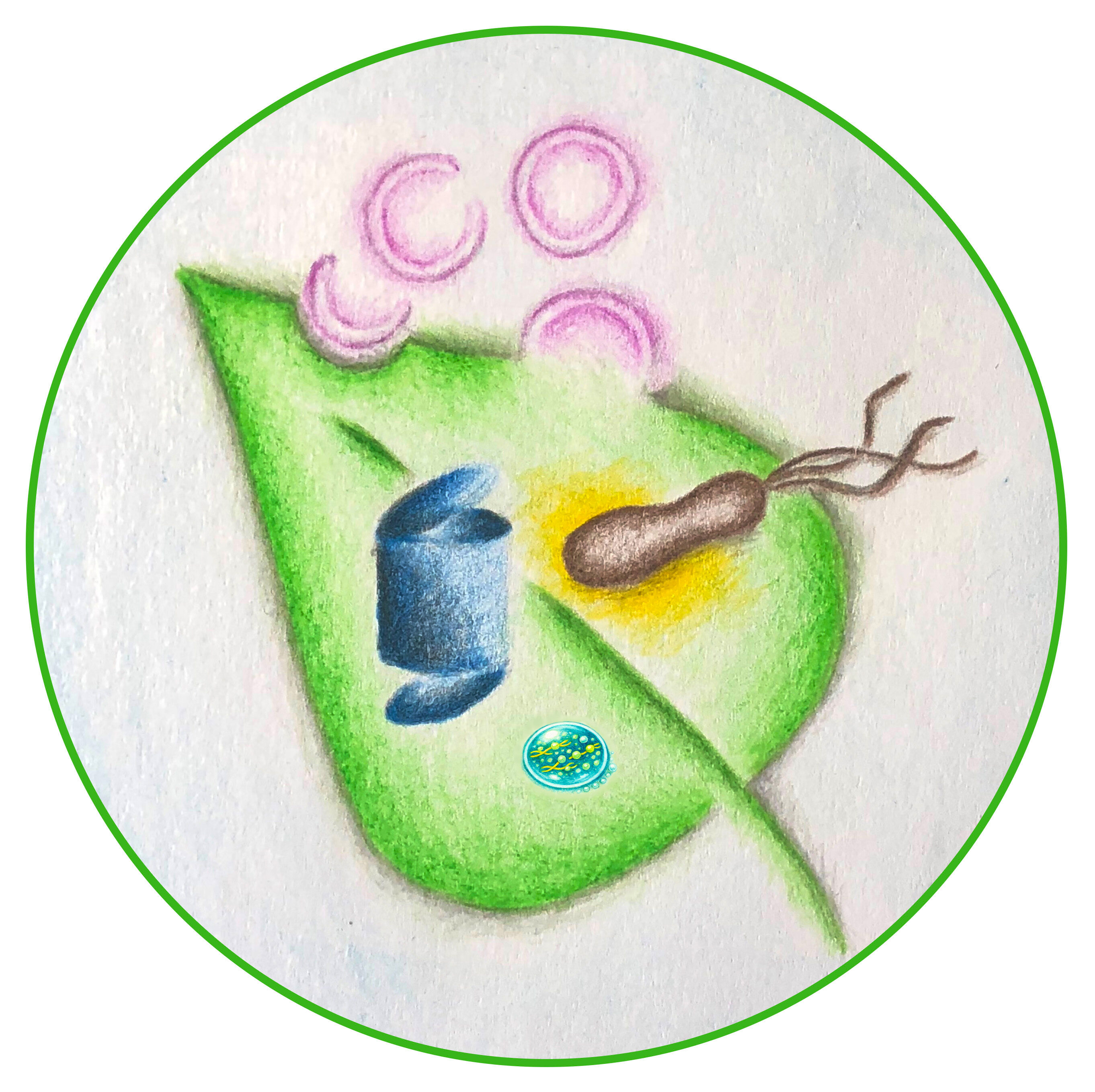
Everything started maybe 9 years ago, during my postdoc in Sweden. My colleague and friend Anders Hafrén, now also a group leader working on P-bodies and stress granules during viral infection, had a couple of leftover DCP1 plants – a P-body marker, from his last experiment.
When he told me “just put your Pseudomonas on it” and “see what happens”, I was honestly a bit like—why would I do this? I was not interested in condensates storing mRNA. I was all about autophagy and proteasomal degradation and their roles in plant immunity.
But Anders insisted. He said this will become huge, and that there is an interplay between degradation machineries, P-bodies, and RNA biology in general. He already saw it back then.

Convinced, but also curious, I used some extra confocal time. This time not imaging my autophagosome “dotties” (which were always a nightmare in leaf tissues…), but bright P-body condensates. And wow – indeed, Pseudomonas actively modified them. Their number increased after 24 hpi (Figure 1).
So the question became: could bacterial pathogens hijack this pathway – and why?
At that time, still focused on degradation, I thought maybe P-bodies are recycled via the proteasome or autophagy, explaining their altered numbers. I went back to my proteomics data and realized that one component associates with ATG8. Could it be that Pseudomonas, by activating autophagy, recycles P-bodies? But I wasn’t fully convinced. The strong increase in P-body foci didn’t quite fit with what we knew about Pseudomonas-triggered autophagy. So I stepped away from the idea, keeping it only as a small side project. But that’s where it initially stalled. Apart from a few preliminary experiments, showing that P-body induction depends on bacterial effector delivery and hinting at interactions between autophagy components and DCPs, we didn’t pursue the project further, as we shifted our focus to other promising directions.
And then things changed.
When Manuel González-Fuente decided to join the lab with his own fellowship after finishing his PhD, I proposed several projects, but this one immediately caught his interest. It was novel, ambitious, and risky. After many discussions, grant writing, and nearly a year of waiting, Manuel secured his DFG fellowship and started working on P-bodies during bacterial infection. From there on, we fully committed to this fascinating but also enigmatic compartment. The beginning was not easy, many experiments didn’t work, we had setbacks, and progress was slow. Even our move to Bochum cost us almost a year of experiments.
But we didn’t give up.
Instead, we kept going analyzing -omics data, refining ideas, and this is when the link between ER stress and P-bodies started to emerge. Manuel presented his exciting project at several conferences, received prizes, awards and encouraging feedback. Eventually, all in all it felt like the first “season” of the story came together, and Manuel started writing the paper, which we preprinted more than a year ago.
Then the real gamble began.
We were excited to be reviewed in a top journal, but quickly realized how tough the process would be. We didn’t give up and eventually submitted the manuscript to Science Advances.

After multiple rounds of revision (and moments where it really looked like we wouldn’t make it), the paper was finally accepted. If you wanna read it you can find it here: https://www.science.org/doi/10.1126/sciadv.aec4477# Huge credit here to Manuel: he always believed in the story, even at times when I had doubts and felt very low (also due to another manuscript that we have been trying to publish since two years – wait for this Thursday!)
Looking back, some, but not all, reviewer feedback actually helped us improve the manuscript and led to additional insights—for example, that Pseudomonas specifically induces P-bodies without triggering stress granules (Figure 2).
So what about season 2? 🔬
There are still many open questions we are now actively working on:
Which mRNAs are selectively repressed in P-bodies? A question Manuel and I have been asked so often when presenting our work at conferences. We will soon conduct polysome profiling and Ribo-seq experiments across different genotypes during bacterial infection.
How exactly does ER stress control P-body assembly? We finally have the genetic material to address this—and a small teaser: P-body assembly depends on transcription factors that regulate ER stress – Manuel and his talented Bachelor student Nea Khalo are currently investigating this.
What defines selective autophagic turnover of P-bodies? This is a hidden gem in our manuscript. We believe we have identified the selective autophagy receptor, and likely also the E3 ligase mediating the degradation of P-body components—but this is still ongoing work that PhD candidate Wentao Luo is trying to solve.
How does HopN1 suppress translation if it is not dependent on P-bodies? For this, we already performed proteomics experiments ~4 years ago in Tübingen and identified several proteins involved in translation regulation and ribosome stalling. Manuel will now continue to follow up on this now that his paper is finally published 😊

How does Pseudomonas inhibit TOR activity? We do not know whether this is dependent on effector proteins or simply the pathogen turing source tissue into a sink (Figure 3). We have some hints that effectors can indeed interact with TOR and manipulate its “properties”. More to come in the future.
What is the role of P-bodies in abiotic stress, and how are they regulated by posttranslational modifications? We have become particularly interested in whether distinct or shared modification signatures control P-body dynamics under different stress conditions, something Thorben Krüger is now beginning to explore.
Final thoughts
This journey would not have been possible without the people behind it.
A very special thank you to Manuel González-Fuente, for his persistence, curiosity, and resilience. He drove this project through 5 years of challenges, setbacks, and revisions, and never lost belief in the story, even when things were not working at all. This paper is a testament to his dedication.
And of course, huge thanks to all co-authors, collaborators, and lab members who contributed along the way, this was truly a collective effort 🙌🌱
Şuayb
